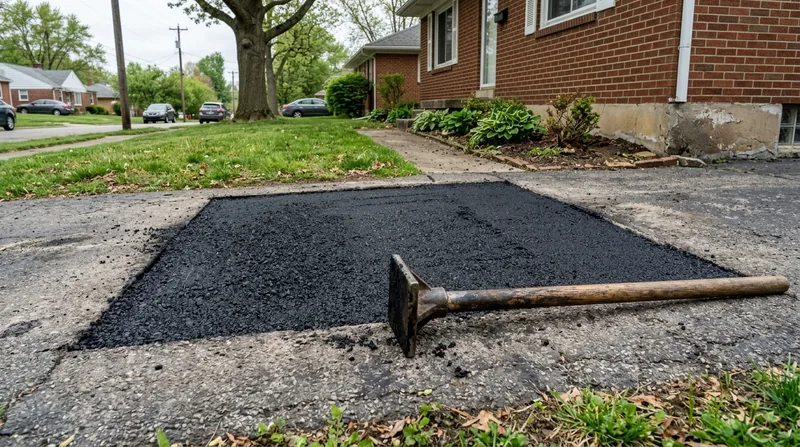




Freeze-thaw cycles, heavy glacial clay, and winter snowplows turn Dayton driveways into repair projects faster than most homeowners expect. The Miami Valley's 40 inches of annual rain, dozens of winter heave cycles, and road salt all work against asphalt surfaces, especially on the post-war ranches of Kettering, Huber Heights, and Riverside, and the aging subdivisions of Centerville and Beavercreek where driveways installed in the 1970s and 1980s are now cracking and sinking. Driveway repair in Dayton means stopping the damage before it spreads, fixing sunken aprons and crumbling edges with full-depth patches that key into sound asphalt instead of skin patches that peel by spring. We tell you honestly when a repair buys you years and when the money belongs in resurfacing instead. Our work comes with a written estimate that names tonnage and thickness, and we've been doing this since 2012.
Why Driveway Repair Matters in Dayton's Climate
Dayton sits on heavy glacial till clay that holds water after rain, and that water is your driveway's worst enemy. When temperatures drop below freezing, that water expands, heaving the asphalt upward and cracking it from underneath. By spring, you have potholes, sunken sections, and crumbling edges that only get worse if you ignore them. A pothole that starts as a six-inch cavity grows into a foot-wide crater by July, and a small edge break spreads into a three-foot section of failed pavement. The freeze-thaw cycle here runs a dozen times every winter, and each cycle does damage.
- Sunken aprons and heaved sections trap water and accelerate deterioration of the base layer underneath.
- Crumbling edges let water into the sub-base and destabilize the entire edge of the drive.
- Snowplow gouges and salt damage create cracks that branch into alligator patterns if left unrepaired.
- Full-depth patches remove the failed section down to the base, compact the base, and install new asphalt that bonds to the sound pavement around it.
Catching these failures early and fixing them right keeps your driveway solid for years instead of watching it fail in pieces.
Key info: In Dayton and Kettering, the worst damage shows up in late March and April when the freeze-thaw cycle peaks and snowplows have run all winter. If you see new cracks or sunken sections by May, a full-depth repair now prevents a $3,000 resurfacing bill in two years.
For more on how potholes form and what repair methods work best, see our pothole repair and asphalt patching page.
How We Repair Driveways in Dayton: Process and Approach
A driveway repair starts with an honest assessment. We measure the failed area, check the base underneath, and decide whether a patch holds or whether resurfacing is the smarter spend. If the damage is isolated (under 30 percent of the surface), a full-depth patch is the answer. If alligator cracking covers more than 40 percent of the drive, or if the base is soft and heaving everywhere, we tell you that resurfacing or replacement is where your money should go. We pull a written estimate with tonnage and thickness specs so you know exactly what you are paying for.
- We locate any buried utilities using Ohio 811 before we break ground, a legal requirement in Ohio.
- We remove the failed asphalt section and haul it away or recycle it as millings for gravel drives.
- We inspect and compact the base layer, proof-rolling it to confirm it is solid before new asphalt goes down.
- We install new hot mix asphalt in the repair area, tying it into the sound pavement around it so water does not seep under the edges.
- We finish the patch level with the surrounding drive so your car does not bounce or drag.
The entire job typically takes one to three days depending on the size and number of patches. You can drive on the repair within 24 hours in cool weather, though full curing takes six to twelve months.
Local example: A Beavercreek homeowner had two heave cracks and a sunken section along the apron where water pooled every spring. We pulled a full-depth patch on all three areas, reset the apron to drain properly, and tied it back into the main drive. Cost was $1,200 for materials and labor. Three years later, that section is still solid, and the rest of the drive has not deteriorated. The repair bought time to plan a full resurfacing in year five or six when the rest of the drive reaches end of life.
Learn more about when resurfacing is the better choice by visiting our asphalt resurfacing and overlay page.
Driveway Repair Methods and When to Use Them
| Repair Method | What It Does | Best For |
|---|---|---|
| Full-Depth Patch | Removes failed asphalt and base down to solid ground, compacts new base, installs new asphalt that bonds to surrounding pavement. | Potholes, sunken sections, heave cracks, crumbling edges when damage is isolated and the rest of the drive is sound. |
| Skin Patch (Not Recommended) | Fills a pothole or crack with asphalt without removing the failed base underneath. | Temporary fix only; peels and fails within one to two years because water gets under the patch and lifts it. |
| Asphalt Resurfacing | Mills the top one to two inches of old asphalt and installs new asphalt over the existing base. | Multiple patches scattered across the drive, alligator cracking over 30 to 40 percent of the surface, surface wear but a solid base underneath. |
| Full-Depth Replacement | Removes all asphalt and base, rebuilds the base from scratch, installs new asphalt. | Extensive base failure, alligator cracking over 50 percent of the surface, sunken or heaving sections across the entire drive. |
The key is matching the method to the scope of damage. Full-depth patches are the most cost-effective repair for isolated failures. If damage is scattered or covers more than 40 percent of the surface, resurfacing saves money in the long run. If the base is failing everywhere, replacement is the only honest answer.
Driveway Repair Cost in Dayton: What to Expect
A full-depth patch in Dayton typically starts at $450 for a small isolated failure (four by eight feet or smaller). Larger patches, multiple repair areas, or complex base work that requires grading and compaction will cost more. A sunken apron or a heave section that needs re-grading before the patch goes down can add $200 to $400 to the bill. If you have three or four patches scattered across your drive, the total usually runs $1,200 to $2,000 depending on size and base condition.
The biggest cost driver is the condition of the base layer underneath the failed asphalt. If the base is soft or wet, we have to remove more material, compact it properly, and sometimes bring in fresh stone to build it back up. A patch over a bad base costs more than a patch over solid ground, but it also holds instead of failing again in two years. We always pull a written estimate on site so you see the tonnage, thickness, and labor before you commit.
If you have multiple patches or extensive cracking, resurfacing often costs less per square foot than patching multiple times. Our pricing page breaks down the costs for different repair and resurfacing options so you can compare the numbers. The honest answer is that a $450 patch today prevents a $3,000 to $5,000 resurfacing bill in two to three years if you catch the damage early.
What to Look for When Hiring a Driveway Repair Contractor Near Me in Dayton
The driveway paving trade has a reputation for door-to-door scams, and that reputation is earned. If someone shows up at your door unsolicited claiming to have leftover asphalt from a nearby job and offering a price that sounds too good, that is a red flag. A legitimate contractor operates from a local address, carries liability insurance, pulls written estimates before starting work, and does not pressure you into a same-day decision or a large cash deposit. Dayton has been here since 2012, and we work from a local shop with local plates. You can verify our insurance, pull references from past jobs in your neighborhood, and get a written estimate with tonnage and thickness before you say yes.
- Ask any contractor for proof of liability insurance and verify coverage limits with the insurance company directly.
- Get written estimates from at least two contractors so you can compare scope, materials, and pricing.
- Ask for references from jobs in your neighborhood, and call at least one to ask about the quality and timeliness of the work.
- Verify that your city or village requires a permit for driveway work and confirm the contractor handles permitting or helps you navigate it.
- Check that the estimate names the tonnage of asphalt, the thickness of the patch or resurfacing, and the cost of labor and materials separately.
- Never pay a large deposit upfront; standard practice is payment on completion or in installments as work progresses.
If you are in a homeowners association or a historic district like Oakwood, Dayton View, or the Oregon District, verify that HOA architectural standards or local historic preservation rules allow the repair method the contractor proposes. Some neighborhoods restrict material choices or require approval before work starts. We help you navigate those requirements, but the rules vary from community to community.
Ready to get a free, no-obligation estimate for your driveway repair? Contact us at (937) 930-3543 or fill out our online form. We respond within 24 hours.
Driveway Repair in Dayton: Pricing Guide
| Service | Price | Details |
|---|---|---|
| Small full-depth patch | Starting at $450 | One isolated failure up to four by eight feet, sound base underneath, standard removal and install |
| Multiple patches or large single patch | Starting at $800 | Two to four separate failures or one patch larger than four by eight feet, includes base inspection and compaction |
| Patch with grading or apron reset | Starting at $1,200 | Repair includes drainage correction, sunken apron reset, or soft base removal and rebuild before asphalt install |
| Extensive repairs or resurfacing | On estimate | Multiple large patches, alligator cracking over 30 percent of surface, or full-depth replacement requires site inspection and material assessment |
| Travel and estimate | Included in quote | No separate call-out fee or mileage charge in Dayton and surrounding service areas within Greater Miami Valley |
| Free written estimate | No obligation | Response within 24 hours, includes tonnage and thickness specs, call (937) 930-3543 or use online form |
Indicative pricing, the exact cost depends on square footage, finish, and site access. Free personalized estimate within 24h at (937) 930-3543.


