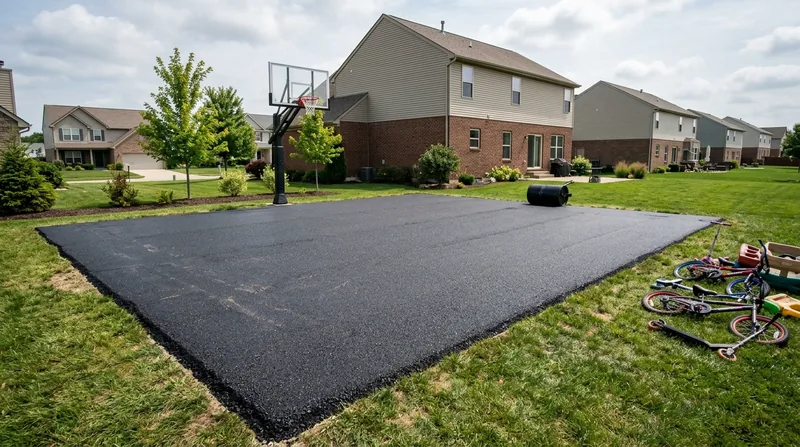




Dayton's post-war brick ranches, 1970s-2000s subdivisions, and newer residential builds in Kettering, Beavercreek, and Centerville sit on heavy glacial till clay that holds water through 40 inches of rain a year and punishes freeze-thaw cycles every winter. Backyard recreation spaces, basketball courts, tennis and pickleball bases, walking paths, and golf cart trails, demand Sports Court & Path Paving in Dayton that stays dead-flat and true through the season and the decades. We build asphalt structures with tight-tolerance surface courses ready for acrylic color systems, so your court plays true and your paths don't heave or crack at the frost line. This is precision paving, not driveway work, and the difference is in the base, the compaction, and the finish.
Why Sports Court & Path Paving Matters in Dayton's Freeze-Thaw Climate
Dayton winters deliver dozens of freeze-thaw cycles that heave standard asphalt and pop edges from December through March. A backyard court or path built on an undersized base will fail in the first season. Proper sports court paving requires a compacted base layer, a binder course, and a tight surface course that sheds water and holds its plane. The acrylic color systems that mark the lines and define play zones sit on top, so the asphalt underneath must be absolutely flat and stable for years.
- We size the base and drainage to handle Dayton's heavy clay and spring melt without settlement or edge failure.
- We compact every layer to specification so the surface stays true through dozens of freeze-thaw cycles each winter.
- We finish the court or path dead-flat with a surface course tight enough for acrylic color systems and line markings.
- We handle grading and drainage so water runs off and does not pond or weaken the base under the court.
A court that moves or cracks under frost heave or settlement will fail the acrylic finish and the play surface, and resurfacing or full replacement costs far more than proper base work at the start.
Key info: Dayton's clay soil and freeze-thaw pattern are the dominant failure mode for recreational paving. The City of Dayton and surrounding villages like Kettering and Huber Heights set grading and drainage standards through their building departments. We help you navigate local permitting and verify that your base and drainage plan meets the code. Verify requirements with your local building department before work begins.
How We Build Sports Court & Path Paving in Dayton
Sports court paving starts below the surface. We begin with site grading and base preparation, removing unsuitable material and compacting the subgrade so it will not settle. We then lay a compacted stone base layer sized to the soil type and the expected load. On top of that goes a binder course of recycled or virgin asphalt, followed by a tight surface course finished to dead-flat with a trowel or laser screed. The result is a court or path ready for acrylic color, line marking, and years of play.
- We excavate and grade the site to proper slope and elevation, removing soft or unsuitable clay and compacting the subgrade.
- We lay a compacted stone base layer sized to your soil and drainage, with proper crown for water runoff.
- We place a binder course of asphalt and compact it to density, creating a stable platform for the finish layer.
- We finish with a tight surface course, screeded and compacted dead-flat so the acrylic and line markings sit on a true plane.
- We proof-roll the surface and make any final adjustments before you apply color and markings.
The entire process takes 5 to 10 working days depending on site conditions and weather. Spring and fall are the ideal seasons for this work in Dayton, when temperatures are stable and the asphalt cures properly. For more information on our base preparation methods, see our gravel driveway and grading page, which covers the same subgrade and compaction principles.
Example: A homeowner in Beavercreek wanted a half-court basketball installation on a backyard sloped toward the house. We graded the site, installed a 4-inch compacted stone base with proper crown to shed water away from the foundation, placed a binder course, and finished with a 1.5-inch surface course screeded dead-flat. The acrylic contractor then applied the court color and lines. The court has held true for three seasons through winter frost heave and spring melt.
Sports Court & Path Paving Methods and Approaches
| Approach | Description | Best For |
|---|---|---|
| Full-depth court paving | Excavate to subgrade, compact stone base, place binder and surface courses, finish dead-flat for acrylic. | New courts, paths, or areas where existing asphalt is gone or unsuitable. |
| Overlay and resurface | Remove old surface if cracked or heaved, prepare base, place new binder and surface courses to dead-flat spec. | Existing courts that have settled or cracked but have a sound base layer underneath. |
| Path and trail paving | Grade and compact subgrade, lay stone base, finish with 1.5 to 2-inch surface course on proper slope for drainage. | Walking paths, golf cart trails, and recreational routes through residential or rural property. |
| Laser-screeded finish | Use laser level and mechanical screed to achieve dead-flat surface within 1/8 inch over 10 feet, critical for acrylic courts. | Tennis, pickleball, and basketball courts where surface flatness is essential for play and color application. |
Sports Court & Path Paving Cost in Dayton: What to Expect
Sports court and path paving in Dayton starts at around $8,500 for a small half-court or short walking path, but cost scales with size, site conditions, and drainage complexity. A full basketball court or tennis court typically runs $12,000 to $18,000 depending on whether the site requires significant grading, the base layer depth needed for your soil, and local permitting. A long golf cart trail or multi-sport pad can exceed $20,000. The single largest cost driver is site preparation: clay soil that needs removal, improper drainage, or slopes that require significant cut or fill will increase the base work and the total price.
Get written estimates from 2 to 3 paving contractors and ask each one to specify the base layer depth, stone type, asphalt tonnage, and surface finish thickness. A contractor who cannot or will not give you tonnage and thickness is not pricing the job honestly. Call us at (937) 930-3543 for a free on-site estimate, and we will walk you through the cost factors specific to your site. For detailed pricing on related services, see our full pricing page.
Sports Court & Path Paving Contractors Near Me: What to Look For
Hiring the right contractor for your court or path paving in Dayton or surrounding areas means verifying that they understand the freeze-thaw climate, can specify a proper base for your soil, and will stand behind their work. Start by checking that any contractor you interview is fully insured and can provide a certificate of insurance on request. Ask for references from similar projects in the Dayton area, especially courts or paths that have survived at least one full winter. Get a written estimate that includes base layer depth, stone type, asphalt tonnage, surface thickness, and the expected finish flatness.
Verify whether your project requires a permit from your local building department. The City of Dayton, Kettering, Beavercreek, Huber Heights, and other municipalities set different rules for site work, grading, and drainage. If your property is in an HOA community in Centerville, Springboro, or Washington Township, check the architectural guidelines before you start, because some HOAs restrict the location or materials for recreational paving. A reputable contractor will help you navigate local permitting and will not start work until permits are in hand. Contact us at (937) 930-3543 or visit our contact page for a free estimate and to discuss your local requirements.
Sports Court & Path Paving in Dayton: Pricing Guide
| Service | Price | Details |
|---|---|---|
| Half-court basketball or small path | Starting at $8,500 | Includes grading, 4-inch stone base, binder course, 1.5-inch surface finish screeded flat for acrylic. |
| Full basketball or tennis court | Starting at $12,000 | Full-size court with proper base, drainage, and laser-screeded surface dead-flat within 1/8 inch tolerance for play. |
| Walking path or golf cart trail per 100 linear feet | Starting at $3,500 | Grading, compacted stone base, asphalt surface on proper slope for drainage through residential or rural property. |
| Complex site with significant grading or drainage | On estimate | Heavy clay removal, base layer depth, crown design, and site-specific drainage require on-site assessment before pricing. |
| Free estimate | Included | Response within 24 hours at (937) 930-3543 with written tonnage and thickness specs, no obligation to book. |
Indicative pricing, the exact cost depends on square footage, finish, and site access. Free personalized estimate within 24h at (937) 930-3543.


