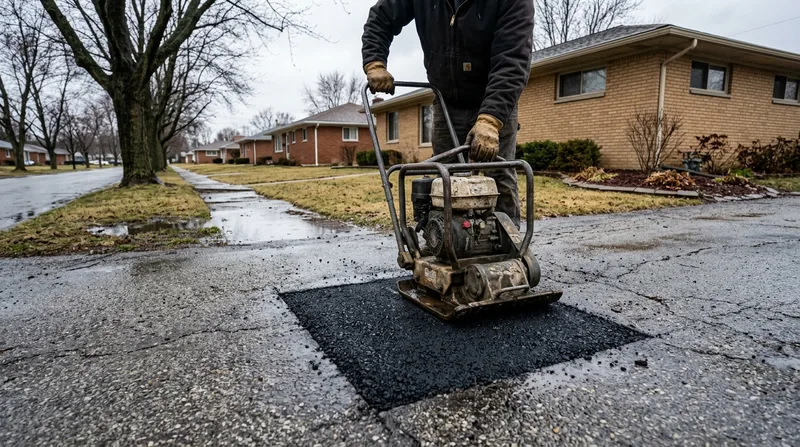




The Miami Valley's freeze-thaw cycle is relentless. Every winter, groundwater trapped in the heavy glacial clay beneath Dayton's streets and driveways expands, heaves the surface, and then leaves voids when it melts. By March and April, those voids collapse into potholes, and a single failed section can spread fast if left unpatched. Pothole repair and asphalt patching in Dayton is not cosmetic work, it is urgent maintenance that stops a small failure from becoming a full-depth replacement. We cut potholes square, tack-coat the walls, and fill them with compacted hot mix, or we use infrared patching to recycle the surface in place for a seamless repair. The difference between a $500 patch in April and a $3,000 resurface in June is the speed of your call. We book fast late-winter assessments so one hole doesn't become a failed section.
Why Pothole Repair Matters in Dayton: Ohio's Freeze-Thaw Assault
Dayton sits on glacial till clay over limestone, terrain that holds water and heaves under freeze-thaw stress. From December through March, dozens of temperature swings pop the surface and leave soft spots. The road salt and snowplows that clear I-75 and the local streets chew edges and accelerate deterioration. Homeowners in Kettering, Huber Heights, and Riverside with post-war brick ranches on single and two-car driveways see their original surfaces fail after forty to fifty years, and potholes are often the first sign of base failure below.
- A single pothole left unpatched can grow into a failed section within one season of freeze-thaw cycles.
- Patching stops water from entering the base layer and prevents accelerated deterioration of surrounding asphalt.
- Late-winter and early-spring assessments catch damage before the busy paving season and cost less than summer repairs.
- Infrared patching bonds seamlessly to existing asphalt with no waiting or surface seams.
- Square-cut patches with proper compaction and tack coat hold longer than temporary cold-patch fixes.
Catching potholes early is the difference between a repair budget and a replacement bill.
Key info: Dayton's spring pothole season peaks March through May as the ground thaws and freeze-thaw cycles finish their work. An assessment in February or early March often costs $450 to $700 and prevents a $3,000 to $5,000 resurface later. Call (937) 930-3543 to schedule your free estimate before the rush.
For more detail on how potholes fit into the larger repair and resurfacing picture, see our guide to driveway repair in Dayton.
How We Repair Potholes and Patch Asphalt: Two Methods, One Goal
A pothole is a failed spot where the asphalt has broken apart and the base below is soft or missing. We assess whether the damage is isolated or part of a larger pattern. If it is isolated, we patch. If the surrounding surface shows alligator cracking or multiple failures across thirty to forty percent or more of the pavement, the money belongs in resurfacing, not patching. For a single pothole or a few scattered failures, we offer two approaches: traditional square-cut and fill, or infrared recycling.
- We cut the pothole into a square or rectangle to create clean, stable walls.
- We sweep and tack-coat the cut surface to bond the new asphalt to the old.
- We fill the hole with compacted hot-mix asphalt in layers, tamping each layer to density.
- Infrared patching heats the existing asphalt and the new material in place, recycling the surface with no seam or waiting period.
- We measure and document the patch so you have a record of the repair for insurance or resale.
Both methods work; infrared is faster and seamless, traditional patching is cost-effective for smaller holes.
Real example: A Centerville homeowner with a two-car driveway noticed two potholes near the apron in late February. We assessed the surrounding surface, found no alligator cracking, and quoted a square-cut patch at $520 for both holes. The repair took three hours, held through the spring thaw, and cost far less than a full resurface. The same homeowner called back in May asking about sealing, but we advised waiting until the patch had cured for six months before any sealcoat work.
If you are uncertain whether your driveway needs patching or resurfacing, our asphalt resurfacing page explains the overlay decision in detail.
Pothole and Patch Repair Methods
| Approach | Description | Best for |
|---|---|---|
| Square-Cut Pothole Patch | Cut the hole square, tack-coat, fill with compacted hot-mix asphalt in layers, tamp to density. | Single potholes or a few scattered failures; cost-effective; holds well when base is sound. |
| Infrared Asphalt Recycling Patch | Heat the existing asphalt and blend in new material in place, recycling the surface with no seam or waiting. | Seamless repairs; no cure time before use; professional appearance; slightly higher cost than square-cut. |
| Full-Depth Patching | Cut through the full asphalt depth, remove failed material and soft base, replace with compacted base and new asphalt. | Potholes with failed base below; prevents water from entering the subgrade; more expensive but solves root cause. |
| Resurfacing or Overlay | Mill or lay new asphalt over the entire failed section, addressing multiple potholes and alligator cracking as one job. | Thirty to forty percent or more of the surface failed; multiple potholes or extensive cracking; long-term solution. |
Pothole Repair and Asphalt Patching Cost in Dayton: What to Expect
A single pothole repair using the square-cut method starts at $450 and typically runs $500 to $800 depending on the size of the hole and the condition of the surrounding base. Infrared patching costs slightly more, from $600 to $1,000 per repair, because it requires specialized equipment and operator time on site. If the pothole has eaten into the base layer or if the surrounding asphalt shows soft spots or water damage, a full-depth patch (cutting through the entire asphalt depth and replacing the base) runs $800 to $1,500 per hole. Multiple potholes on the same driveway can be bundled at a lower per-hole cost than single isolated repairs.
The main factors that move cost up are the size of the failed area, the depth of deterioration below the surface, and the condition of the base layer. A small pothole on a driveway with a solid base costs far less than a large failure in a driveway where water has compromised the subgrade. If the damage covers more than thirty to forty percent of your driveway surface or shows extensive alligator cracking, patching is not the right answer, and we will recommend resurfacing or overlay instead. We provide written estimates with tonnage and material specs so you know exactly what the work includes.
For a detailed pricing overview covering all service types and options, visit our pricing page.
Hiring a Pothole Repair and Asphalt Patching Contractor Near Dayton: What to Verify
The asphalt paving trade attracts opportunistic work. Unsolicited door-to-door offers claiming leftover asphalt from a nearby job, requests for large cash deposits, no written contract, and out-of-state plates are red flags. A legitimate local contractor has a Dayton address, local phone number, verifiable insurance, and provides a written estimate with material specs and tonnage before you commit.
- Verify that any contractor you call carries liability insurance and can provide a certificate on request.
- Ask for a written estimate that lists the patch method, square footage or tonnage, and material type.
- Get two or three estimates so you understand the range and can spot outliers.
- Ask for references from recent pothole or patching work in your neighborhood.
- Check whether your city or village requires permits for driveway repair, and verify that the contractor understands local rules.
- If your driveway is in an HOA community, confirm that the repair method complies with architectural standards before you book.
A local contractor with a Dayton address and a track record in your neighborhood is your best protection against scams and poor workmanship.
Ready to get started? Contact us for a free estimate. We respond within 24 hours at (937) 930-3543 and provide written quotes with no obligation.
Pothole Repair & Asphalt Patching in Dayton: Pricing Guide
| Service | Price | Details |
|---|---|---|
| Single pothole patch (square-cut) | Starting at $450 | Cost increases with hole size and base condition; typically $500 to $800 for standard residential pothole |
| Infrared asphalt recycling patch | Starting at $600 | Seamless repair with no waiting; slightly higher than square-cut due to equipment and operator time on site |
| Full-depth pothole patch | Starting at $800 | Cut through asphalt and base layer, replace failed material; necessary when base is soft or water-damaged below |
| Multiple potholes on same driveway | On estimate | Per-hole cost decreases when bundling; if thirty to forty percent or more of surface is failed, resurfacing may be more cost-effective |
| Free estimate | No charge | Written quote with material specs and tonnage; response within 24 hours at (937) 930-3543; no obligation to book |
Indicative pricing, the exact cost depends on square footage, finish, and site access. Free personalized estimate within 24h at (937) 930-3543.


