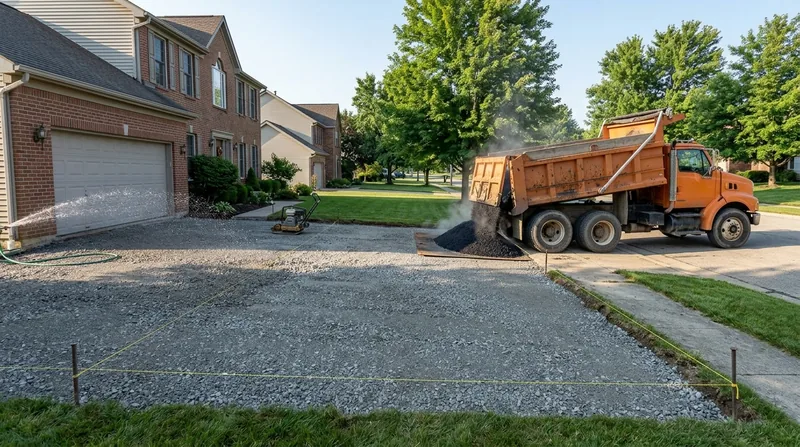




The Miami Valley's freeze-thaw cycles, heavy glacial clay, and decades of road salt chew through asphalt from December to March, and by mid-spring, homeowners across Dayton, Kettering, Huber Heights, and Centerville face the hard choice: patch the surface again or rebuild it. When driveway replacement in Dayton becomes the only honest option, the base is gone, alligator cracking runs section to section, and no overlay will hold. We remove the old pavement, rebuild the 304 base over Miami Valley clay, and pave a binder-plus-surface structure that restarts the 20-to-30-year lifecycle. Written estimates include tonnage and thickness, and we help you navigate local permitting before we dig.
When Your Driveway Has Reached the End: Why Replacement Beats Repair in Dayton
A full driveway replacement is the answer when patching or resurfacing will not hold. Alligator cracking that spans thirty to forty percent of the surface means the base layer has failed, frost heave has cracked the structure, or water has undermined the subgrade. In the post-war brick ranches of Huber Heights and Riverside, or the 1970s-2000s subdivisions of Centerville and Beavercreek, driveways that are now thirty to forty years old often sit on inadequate base prep and show these signs all at once. A fresh asphalt overlay over a failed base is money thrown away; it will crack within one to two seasons. Replacement removes that risk, rebuilds the foundation, and gives you a driveway that will perform for two to three decades.
- We remove the old asphalt and haul it off-site for recycling or disposal.
- We excavate and inspect the subgrade to identify soft spots, poor drainage, or frost heave damage.
- We install a compacted 304 base four to six inches deep, proof-rolled and graded for drainage away from your home and foundation.
- We pave a binder course plus a top course of hot mix asphalt, finished to the proper crown and edges.
- We include written tonnage and thickness specifications on every estimate.
A full replacement is a two-to-three-day job for a typical residential driveway, depending on size and site access. The result is a structurally sound drive that handles the Miami Valley's spring thaw and winter salt without premature failure.
Key info: In Oakwood's stone mansions with long curved drives under old oaks, or the alley garages of the Oregon District, we work around mature trees and site constraints. Dayton's municipal permitting for driveway aprons, culvert work, and curb cuts varies by neighborhood; we help you verify what your local building department requires before we start.
For more on when repair makes sense instead, see our driveway repair page.
How We Handle a Full Driveway Replacement: Step-by-Step in Dayton
Replacement work is sequenced to minimize disruption and ensure a solid foundation. We start with an on-site estimate that includes measurements, subgrade assessment, and a clear quote with tonnage and thickness. Once you approve, we call Ohio 811 for utility locates (required by law before any excavation), schedule the work, and complete the job in the April-through-November paving season when hot mix is available.
- Mobilize and protect the site, marking utilities and setting up equipment staging.
- Remove the old asphalt by milling or full excavation, depending on base condition and site reuse.
- Grade and compact the subgrade, proof-roll to identify soft spots, and correct drainage slopes.
- Install the 304 base in lifts, rolling each lift to 95 percent standard Proctor density.
- Pave the binder and surface courses while the mix is hot, finishing edges and the crown in one continuous pour.
- Cool and cure for 24 to 48 hours before you drive on it; avoid sealcoating for six to twelve months while the asphalt fully hardens.
In a Centerville or Beavercreek subdivision where multiple driveways are aging together, we often complete three to four jobs in the same week, which keeps our schedule efficient and your cost reasonable.
Local example: A typical two-car driveway in Kettering, 20 feet wide by 40 feet long with a failed base and alligator cracking, takes two days to remove, grade, base, and pave. We haul the old asphalt to a recycling facility and deliver the new drive ready to use within 48 hours of completion.
For details on asphalt milling and removal, see our dedicated page.
Replacement Methods and Approaches
| Approach | Description | Best for |
|---|---|---|
| Full-Depth Removal and Rebuild | Excavate all old asphalt and base, inspect and grade the subgrade, install new 304 base and asphalt structure from the ground up. | Failed base, severe frost heave, poor drainage, or when a new apron or widening is planned. |
| Mill and Full-Depth Replacement | Mill the top 1.5 to 2 inches of asphalt, remove remaining base if damaged, rebuild with new base and surface course. | When the base is salvageable but the top course is badly cracked or rutted. |
| Excavation with Recycled Asphalt Base | Remove old asphalt, grade subgrade, use recycled asphalt millings (RAP) as the base layer, top with new hot mix. | Budget-conscious replacement on stable subgrades; rural driveways or secondary parking areas. |
| Grading and Base Prep Only | Excavate old asphalt, correct drainage, compact subgrade, and prepare for new paving by a future contractor. | Phased projects or when you want to stage the work over two seasons. |
Every replacement includes a written estimate with tonnage, thickness, and site-specific details. We measure your drive, assess the subgrade, and quote the work before any commitment.
Driveway Replacement Cost in Dayton: What to Expect
Driveway replacement pricing starts at approximately $7 per square foot for a straightforward full-depth removal and rebuild on stable subgrade. A typical two-car driveway of 800 to 1,000 square feet runs $5,600 to $7,000, plus or minus for site access, existing base condition, and local permitting. Factors that increase cost include poor subgrade requiring additional fill, extensive frost heave repair, difficult site access that limits equipment, or municipal requirements for curb cuts and stormwater management.
The best way to know your actual cost is a free on-site estimate. We measure, assess the site, discuss your goals, and provide a written quote with tonnage and thickness. Comparing two or three estimates from different contractors is smart; look for estimates that include base thickness, asphalt depth, and total tonnage, not just a per-square-foot figure with no detail.
See our pricing page for more detail on factors that move the number up or down.
Driveway Replacement Near Me: What Dayton Homeowners Should Know When Hiring
Choosing a contractor for driveway replacement is a major decision, and the historic fraud in this trade is the itinerant door-to-door crew with out-of-state plates, no written contract, and a price that is too good to be true. A local, verifiable contractor is your strongest protection. Ask for an estimate in writing with tonnage and thickness, check references from previous jobs in your neighborhood, and verify that your contractor carries liability insurance.
Permitting varies by municipality. Dayton, Kettering, Huber Heights, Centerville, and other cities in the Miami Valley each set their own rules for driveway aprons, culvert work, and impervious-surface limits. If your drive is in a historic district like the Oregon District or St. Anne's Hill, or if you live in a master-planned community like Centerville or Springboro, check with your local building department or HOA before you start; some neighborhoods restrict material, color, or width. We help you navigate that process and can tell you what permits your city requires, but you are responsible for verifying with your building department. Call (937) 930-3543 to schedule a free estimate and discuss what your local rules are.
For a complete guide to hiring a contractor, contact us or call (937) 930-3543.
Driveway Replacement in Dayton: Pricing Guide
| Service | Price | Details |
|---|---|---|
| Full-depth replacement, standard subgrade | Starting at $7/sq ft | Excavation, 304 base, binder and surface course, two-car driveway typically 800-1,000 square feet |
| Replacement with poor subgrade or frost heave repair | Starting at $8-9/sq ft | Additional fill, compaction, or drainage correction increases base preparation cost and labor |
| Replacement with limited site access or mature trees | Starting at $8-10/sq ft | Hand work, smaller equipment, or phased staging around structures and vegetation adds time and cost |
| Replacement with municipal permitting and curb work | On estimate | Apron, culvert, or curb-cut work requires site inspection and coordination with local building department |
| Travel and estimate | Included and free | No mileage fee or call-out charge in Dayton and surrounding areas; response within 24 hours |
Indicative pricing, the exact cost depends on square footage, finish, and site access. Free personalized estimate within 24h at (937) 930-3543.


