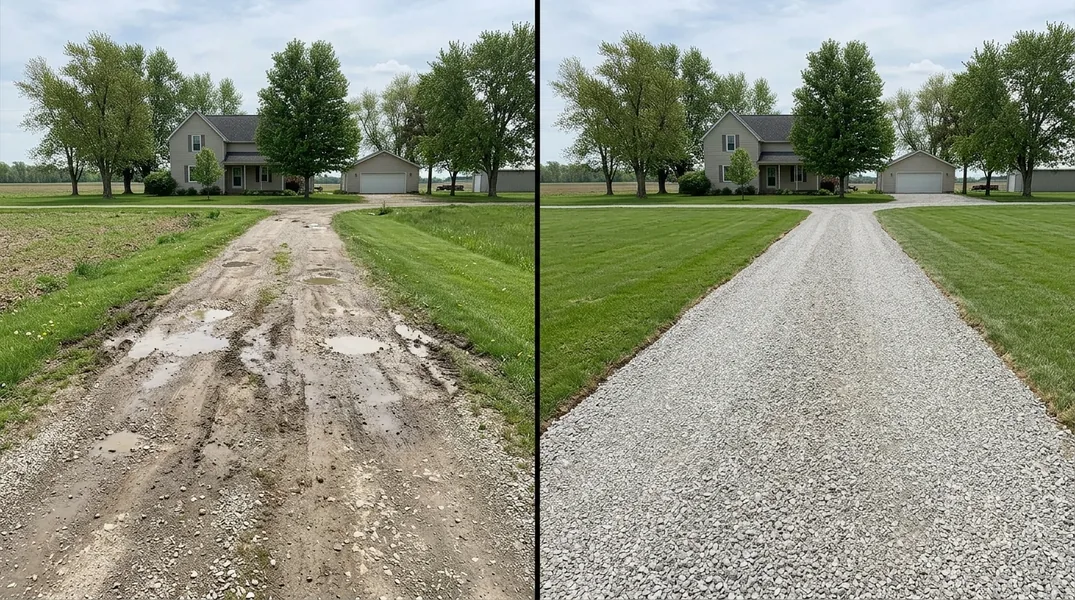
Why Dayton Driveways Struggle with Drainage
If you live in Dayton and notice water pooling on your driveway after rain, you're not alone. The Miami Valley region sits on notoriously challenging clay soil that doesn't drain naturally. This heavy, compacted clay holds moisture like a sponge and prevents water from percolating downward, creating standing water that damages your asphalt and creates safety hazards.
Poor driveway drainage isn't just an aesthetic problem. Water that sits on your asphalt surface seeps into cracks, freezes during winter, and expands, accelerating pavement deterioration. In Dayton's freeze-thaw climate, this cycle repeats dozens of times each year, turning minor drainage issues into major structural damage. The longer you ignore water pooling, the more expensive repairs become. Understanding why your driveway drains poorly is the first step toward fixing it properly.
Understanding Water Pooling on Your Driveway
Water pooling on a driveway happens when the surface elevation is too flat or when surrounding grade slopes toward the pavement instead of away from it. In many Dayton properties, the original driveway installation didn't account for proper slope, or decades of settling have flattened what little drainage angle existed. Some homeowners also discover that lawn grading or landscaping changes have inadvertently redirected runoff directly onto their asphalt.
The clay soils common throughout the Miami Valley compound this problem. Unlike sandy or loamy soils that allow water to drain naturally, clay is nearly impermeable. Even if your driveway has the correct slope, the surrounding clay soil can't absorb water fast enough, causing it to pool along the edges or in low spots. This is why generic driveway solutions work poorly in our region. You need drainage strategies specifically designed for clay-heavy terrain and the unique challenges of the Miami Valley.
Driveway French Drain Solutions for Clay Soil
A driveway French drain is one of the most effective Dayton homeowners can install to combat water pooling. This drainage system consists of a perforated pipe buried in a gravel-filled trench, typically installed along the edges or perimeter of the driveway. Water is directed into the gravel bed, where it flows through the perforated pipe and away from your pavement, either to a storm drain, a dry well, or a lower grade area on your property.
French drains work exceptionally well in clay-heavy soil because they bypass the clay's poor drainage capacity entirely. Instead of relying on the soil to absorb water, the system actively channels it away. The gravel surrounding the pipe acts as a filter, preventing clay particles from clogging the perforations. For homeowners in the Miami Valley dealing with persistent pooling, a properly installed French drain can be transformative. The key is correct slope and sizing, which is why professional installation matters. A poorly designed French drain will fail quickly, leaving you with the same problems.
Trench Drain Driveway Systems: A Modern Approach
A trench drain driveway system offers a more visible but highly effective alternative to French drains. These are surface-level or shallow-subsurface channels, typically lined with a grate or cover, that run along the edge of your driveway. Water flows directly into the trench, where it's channeled away through an underground pipe system. Trench drains are especially popular for commercial properties and newer residential installations because they provide immediate, reliable drainage without relying on soil permeability.
In clay-dominated areas like the Miami Valley, trench drains eliminate the guesswork. They don't depend on your soil's drainage capacity at all. The system actively collects and removes water before it can pool or infiltrate your asphalt. Trench drains are also easier to maintain and repair than French drains, since they're more accessible. If you're planning new Asphalt Driveway Paving & Installation, incorporating a trench drain during construction costs far less than retrofitting one later. For existing driveways with severe pooling, a trench drain is often worth the investment to prevent costly Driveway Repair down the line.
Regrading and Slope Correction for Better Drainage
Sometimes the best driveway drainage solution is simpler than you think. If water pools in low spots, regrading the driveway surface can redirect it toward the edges and away from the pavement. This involves carefully adjusting the slope of your asphalt so that water naturally flows downhill and away from your home and foundation. Proper slope is typically 1 to 2 percent, which is barely noticeable to the eye but makes a dramatic difference in drainage performance.
Regrading works best when combined with Asphalt Resurfacing & Overlay, which allows professionals to rebuild the surface with correct elevation and pitch. If your existing driveway is severely damaged or sunken, this is often the most cost-effective approach. The surrounding grade also matters. If your lawn slopes toward the driveway, water will always pool there, no matter how well your asphalt is sloped. A comprehensive solution addresses both the driveway surface and the surrounding landscape grading to ensure water flows away from your pavement in all directions.
When to Call a Professional Drainage Specialist Near Me
Assessing driveway drainage problems requires expertise. What looks like a simple pooling issue might actually indicate deeper problems with foundation grading, subsurface water flow, or soil composition. Professional drainage specialists can evaluate your property's topography, soil type, and water patterns to recommend the right solution. In the Miami Valley, where clay soil is universal, a professional who understands regional conditions will provide far better guidance than generic advice.
If you're dealing with persistent water pooling, foundation moisture issues, or recurring asphalt damage from water infiltration, it's time to get a free estimate from Dayton Asphalt Paving. Our team has spent years solving drainage challenges specific to clay-heavy soil. We can assess your situation, explain your options, and design a drainage system that actually works for your property. Call us at (937) 930-3543 to schedule a consultation, or visit our website at https://dayton-asphalt-paving.com to learn more about our drainage solutions and other services.
Looking for a professional asphalt paving contractor in Dayton? Dayton Asphalt Paving responds fast for all your asphalt paving needs.
Get a Free Quote